
How to Legalize a Basement Apartment in Oakville & Halton Hills (Step-by-Step 2025 Guide)
Turning your basement into a legal secondary suite is one of the most powerful ways to create long-term rental income and increase the value of your home in Oakville or Halton Hills. But to protect your family and your tenants – and avoid fines or insurance problems – the suite must meet the Ontario Building Code, Fire Code and local municipal bylaws.
This guide walks you through the full process of legalizing a basement apartment, from checking zoning and planning requirements to permits, construction and final registration. It is written for homeowners who are considering a project with a professional contractor such as MyAurora’s basement renovation and legal suite services.
What Counts as a Legal Basement Apartment in Ontario?
A legal basement apartment (also called a secondary suite, accessory apartment, ARU or two-unit house) is a self-contained dwelling unit inside your home with its own kitchen, bathroom, sleeping area and safe exits. To be legal, the unit must:
- Have a proper bedroom, kitchen, bathroom and living area with adequate natural light and ventilation.
- Meet current Ontario Building Code standards for ceiling height, fire separation, soundproofing, egress windows or exits, and smoke/CO alarms.
- Comply with local zoning rules for second units, including parking and lot size requirements.
- Be built under a valid building permit with inspections, and in Halton Hills, be registered as an Additional Residential Unit (ARU) or two-unit house.
- Follow the Ontario Fire Code and local property standards so that tenants can live safely.
If your current basement apartment was built without permits or does not meet these standards, it is considered an illegal unit. Legalizing it usually involves design changes, upgrades and inspections – but in most cases, it is possible and financially worthwhile.
Step 1 – Confirm Zoning & Eligibility in Oakville or Halton Hills
Before investing in drawings or construction, confirm that a second unit is allowed on your lot. In most residential zones across Ontario, basement apartments are now permitted, but there are still rules about:
- How many units are allowed on one property.
- Minimum lot size and lot coverage.
- Required parking spaces (often one extra space for the unit).
- Location of entrances and exterior stairs.
For Oakville, the Town’s building and planning departments can confirm whether your address allows an accessory apartment and whether there are special requirements such as heritage, conservation or floodplain restrictions.
In Halton Hills, basement apartments are treated as Additional Residential Units (ARUs) or two-unit houses. These units must comply with zoning and then be registered with the Town through a one-time application process once all work is complete.
Tip: When you contact the municipality, have your address, lot type (detached, semi-detached, townhouse) and any previous permit documents ready. Ask specifically: “Can I add or legalize a basement secondary suite at this address, and what are the parking requirements?”
Step 2 – Assess Your Existing Basement Against Code Requirements
Once you know a legal suite is allowed, the next step is a detailed basement assessment. At MyAurora, we start every legal suite project with an on-site review to understand what upgrades are required. Key items include:
- Ceiling height: Minimum clear heights depend on the age of the home and which part of the 2024 Ontario Building Code applies. Newer homes usually need close to 6'11" in most areas, older homes may have slightly reduced allowances.
- Fire separation: Walls and ceilings between units and common areas typically need a continuous fire-rated assembly (for example, enhanced drywall and protected penetrations) to slow flames and smoke.
- Egress windows or exits: At least one escape route must meet size and height rules so occupants can safely exit in a fire. This may mean enlarging a window or adding a walk-out or side-door entrance.
- Smoke and CO alarms: Interconnected, hard-wired alarms with battery backup are required in each unit and sometimes in shared spaces.
- Ventilation & HVAC: The heating and ventilation system must provide adequate fresh air and temperature control for the suite, with proper ducting and fire dampers where required.
- Plumbing & electrical capacity: Enough service for a full kitchen, bathroom, laundry and plugs, with all electrical work inspected by ESA.
- Moisture control: Signs of water infiltration, mould, inadequate insulation or poor drainage must be corrected before finishing.
After this assessment, you should have a clear picture of whether you are starting from an unfinished shell or modifying an existing (possibly illegal) basement apartment. This will shape the design, timeline and budget.
Step 3 – Plan Your Design, Budget & Financing
A legal basement apartment is more complex than a cosmetic remodel, because every decision must support code compliance. Work with a qualified designer or BCIN-licensed professional and a contractor who regularly delivers legal secondary suites in the GTA.
Key design decisions for a legal basement suite
- Layout: Number of bedrooms, open-concept vs separate rooms, and where the entrance and stairs will be.
- Kitchen: Full-size vs compact, venting for range hood, and where plumbing can be run efficiently.
- Bathroom: Shower vs tub, fan venting, and distance to existing drains to reduce concrete work.
- Soundproofing: Extra insulation, resilient channels and acoustic ceilings under key areas like bedrooms.
- Storage & shared spaces: How to separate mechanical rooms, laundry and storage between you and the tenant.
To estimate costs, you can use both market research and tools like the MyAurora basement renovation cost calculator and our main guide on basement renovation vs legal basement suites. Many Oakville and Halton Hills legal suites fall in the $45,000–$80,000 range for about 1,000 sq.ft, depending on structure, finishes and how much existing work must be corrected.
Step 4 – Apply for Building Permits
With a design and budget in place, your designer or contractor prepares a building permit application. For both Oakville and Halton Hills, this typically includes:
- Completed application forms and owner authorization.
- Scaled floor plans, elevations and sections showing both the main dwelling and the new suite.
- Details of fire separation, exits, windows, HVAC, plumbing and electrical layouts.
- Site plan showing parking spaces, exterior stairs and any new entrances or walkouts.
- Applicable fees and any additional approvals (heritage, conservation, septic, etc., if required).
In Oakville, permit applications are now handled through an online portal. In Halton Hills, applications can be submitted electronically or in person depending on the project. The municipality will review zoning first, then building code details. They may return comments that your designer or contractor must address before the permit is issued.
At MyAurora, we include drawings, permit submission and responses to municipal comments as part of our legal suite package, so homeowners don’t have to navigate the paperwork on their own.
Step 5 – Construction, Inspections & Quality Finishing
Once the permit is approved, construction can begin. A typical legal basement conversion includes:
- Framing and structural changes for new walls, doors and bulkheads.
- Installation of new or upgraded fire-rated assemblies, including drywall, fire caulking and protected penetrations.
- Rough-in plumbing and electrical, with ESA inspections and pressure tests as required.
- New or enlarged egress windows and/or exterior entrances.
- HVAC reconfiguration, new ducts or separate controls where needed.
- Insulation, vapour barrier and moisture management upgrades.
- Drywall, flooring, trim, interior doors and hardware.
- Kitchen cabinets, countertops, backsplash and appliances.
- Bathroom tiling, fixtures, fan venting and waterproofing details.
- Final interior painting and touch-ups for a clean, move-in-ready finish.
The building department will schedule several inspections (for example: framing, insulation, plumbing, electrical and final). Passing these inspections is what confirms that your suite is being built to the approved plans and code.
A legal basement apartment should always be built by a contractor who carries proper liability insurance, WSIB coverage and written contracts. This protects you if something goes wrong during construction and helps prevent disputes when it’s time for final payment.
Step 6 – Final Approval, Registration & Renting Your Suite
After the last inspection is passed, you will receive final approval from the building department. In Halton Hills, you must also complete the Additional Residential Unit (ARU) or two-unit house registration process so that your property appears on the Town’s registry of legal units. In Oakville, your permit record and final inspection reports serve as proof that the unit was built legally.
At this stage, MyAurora provides a handover package with permit records, inspection approvals, photos and warranty information. Keep these documents safe – they are important for:
- Insurance coverage for the rental unit.
- Mortgage refinancing or future property sales.
- Discussions with accountants about rental income and expenses.
- Showing prospective tenants that the suite is safe and legal.
How Long Does It Take to Legalize a Basement Apartment?
Timelines vary by municipality and project complexity, but most legalizations in Oakville and Halton Hills fall into these ranges:
| Phase | Typical Timeframe | Notes |
|---|---|---|
| Initial assessment & design | 2–4 weeks | Includes site visit, measurements, design options and budget review. |
| Permit review | 4–10 weeks | Depends on municipal workload and whether revisions are needed. |
| Construction | 8–16 weeks | Influenced by structural changes, window/entrance work and finish level. |
| Final approvals & registration | 2–6 weeks | Includes last inspections, ARU registration (Halton Hills) and documentation. |
Overall, many homeowners should plan on 4–8 months from first consultation to a fully legal, rent-ready suite.
Is Legalizing a Basement Apartment Worth It?
For most owners in Oakville and Halton Hills, the answer is yes – especially if you plan to hold the property for several years. A properly designed legal suite can:
- Generate $1,800–$2,400+ per month in rental income, depending on size and finishes.
- Improve your mortgage approval or refinancing options by adding verified rental income.
- Increase resale value by tens of thousands of dollars because buyers see it as a stable investment.
- Reduce risk compared to an illegal suite, which can trigger fines, insurance problems or orders to remove the unit.
You can compare the numbers in detail using our main basement renovation vs legal suite breakdown and our cost article on basement renovation budgets in Oakville.
Get Help Legalizing Your Basement Apartment with MyAurora
If you are serious about creating a safe, compliant and profitable basement apartment in Oakville, Halton Hills or nearby GTA areas, partnering with a dedicated renovation team makes the process far easier.
MyAurora can help you with:
- On-site assessments to review ceiling height, exits, moisture, fire separation and structural conditions.
- Design and permit drawings for legal secondary suites, including code-compliant layouts and details.
- Full construction – framing, mechanicals, finishes and interior painting – managed by a single project team.
- Coordination of all municipal inspections and, in Halton Hills, guidance on ARU registration.
- Clear payment milestones, written warranties and a documented handover package at completion.
Ready to find out what it would take to legalize your own basement apartment? Request a free, no-obligation basement assessment:
Call +1 (437) 985-2935 or email info@myauroras.com and mention that you are interested in a legal basement conversion in Oakville or Halton Hills. We will review your goals, rough budget and timeline, then suggest the best path to make your suite safe, rentable and fully compliant.
Legal Basement Apartment for Mortgage Help
Legal Suite

 Before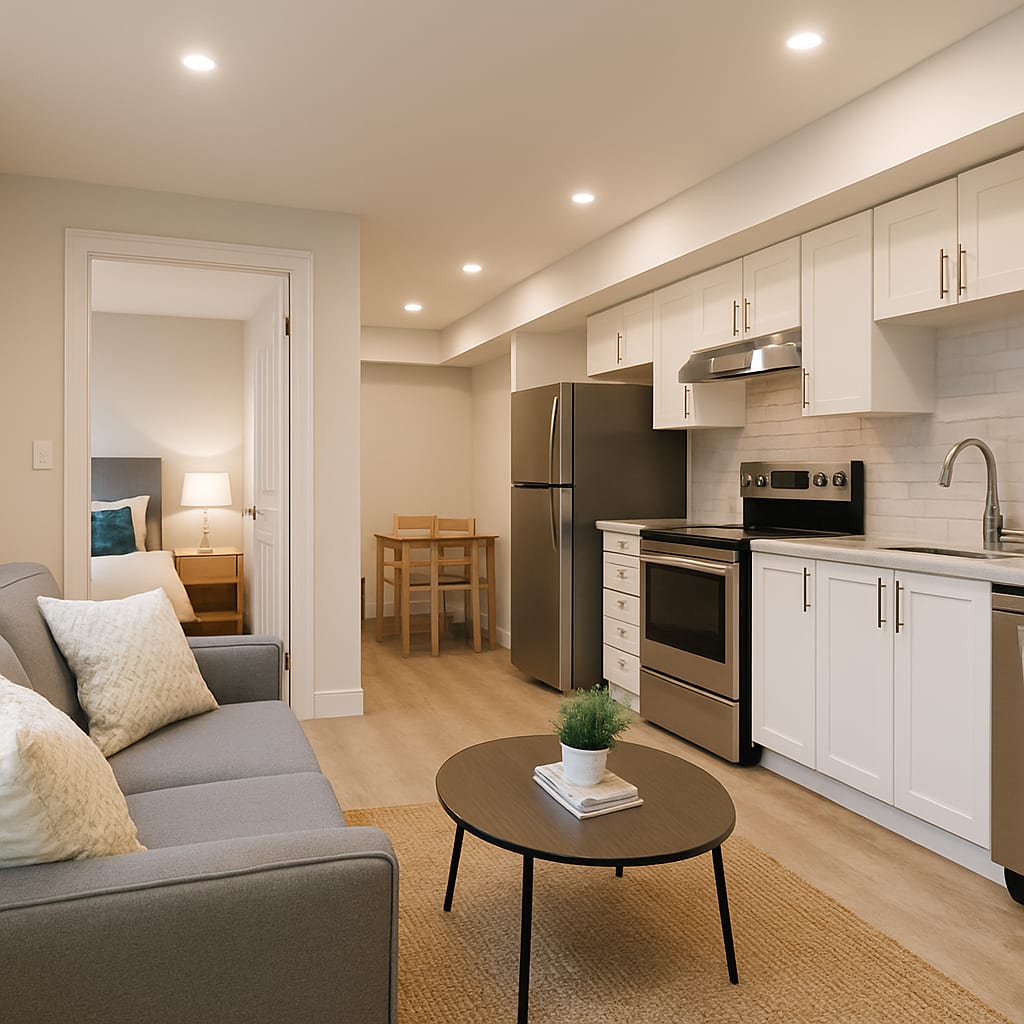
 After
Afterincrease resale value. The existing basement was partially finished but did not meet Ontario Building Code for ceiling height, egress or fire separation.MyAurora redesigned the layout with a bedroom, open living area, compact kitchen and 3-piece bath, added 45-minute fire separation, upgraded the HVAC, and coordinated permits plus all city and ESA inspections.
- Scope: Full legal secondary suite with separate entrance, kitchen, bath, laundry
- Investment range: approx. $65,000–$75,000
- Timeline: 14 weeks including design, permits and inspections
- Result: Rented shortly after completion at about $2,050/month
- Estimated payback: roughly 3–4 years based on local rents and low vacancy
Family Basement with Home Office & Media Room
Living Space

 Before
 After
After- Scope: Framing, insulation, drywall, LVP flooring, pot lights, storage, paint
- Investment range: approx. $28,000–$34,000
- Timeline: 6–7 weeks once permits and selections were finalized
- Result: Added a dedicated office plus family room, improving daily use of the home
- Value impact: Realtor estimated 60–70% cost recovery at resale in the current market
In-Law Basement Suite for Multi-Generational Living
In-Law Suite

 Before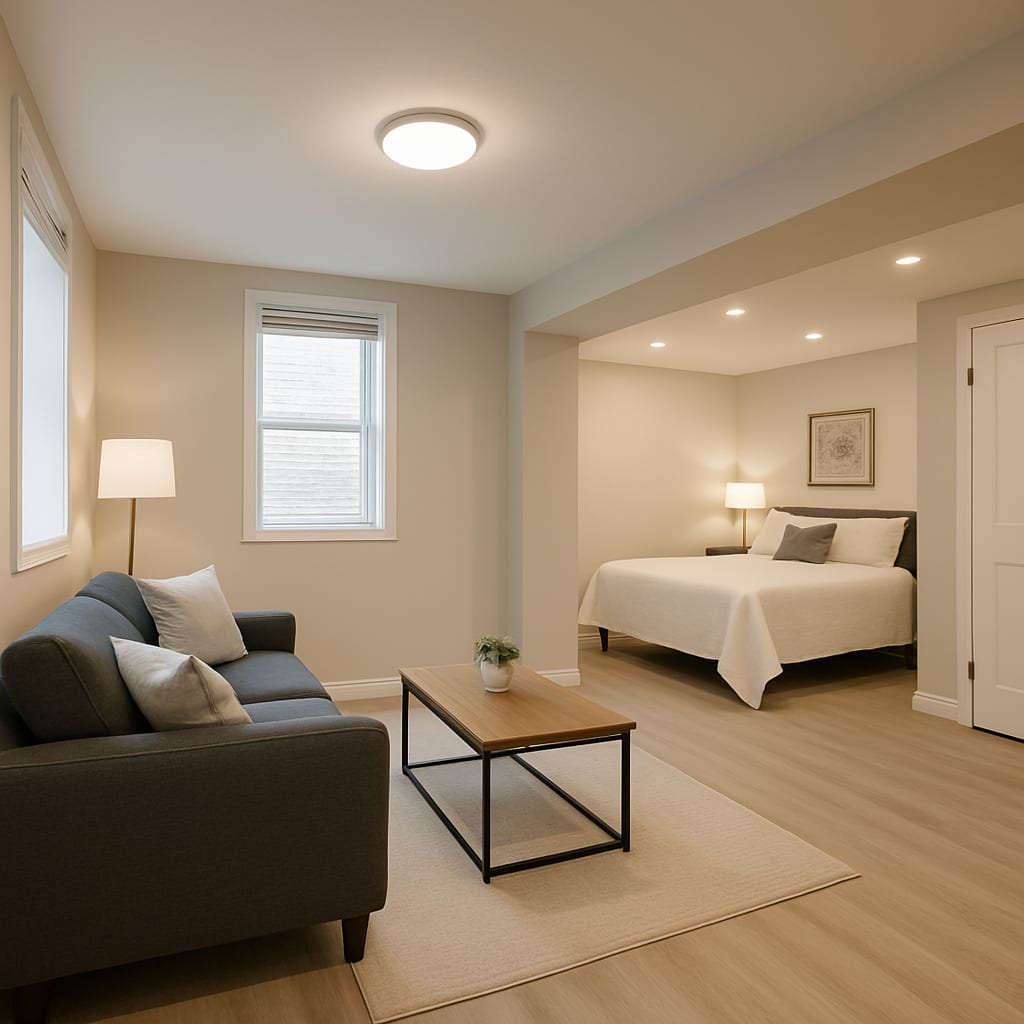
 After
After- Scope: Layout redesign, new bathroom, upgraded electrical, sound-dampening, finishes
- Investment range: approx. $48,000–$58,000
- Timeline: about 9–10 weeks from demolition to final walkthrough
- Result: Private in-law suite that keeps family close and can later be adapted for rental
- Value impact: Extra flexibility made the property more attractive to future buyers
Basement Refresh with Moisture Improvements
Refresh & Repair
 Before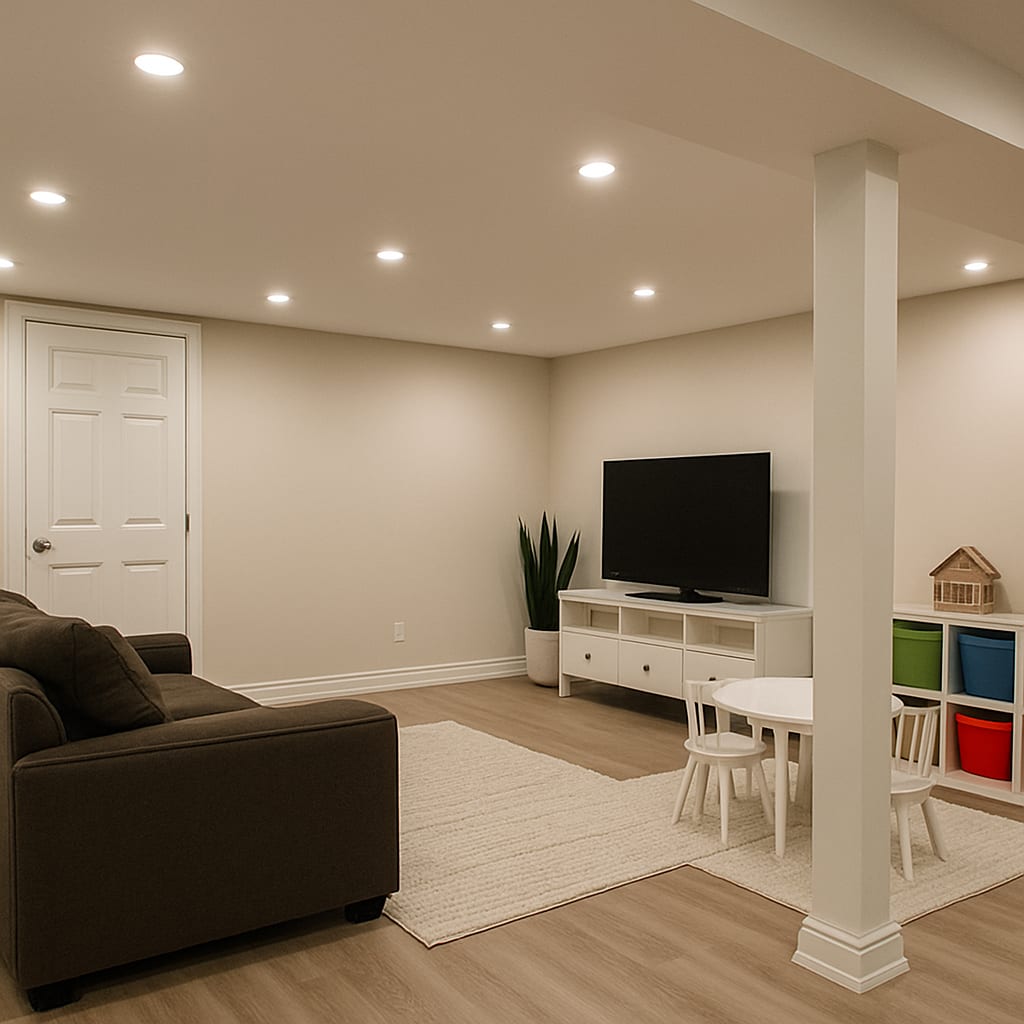
 After
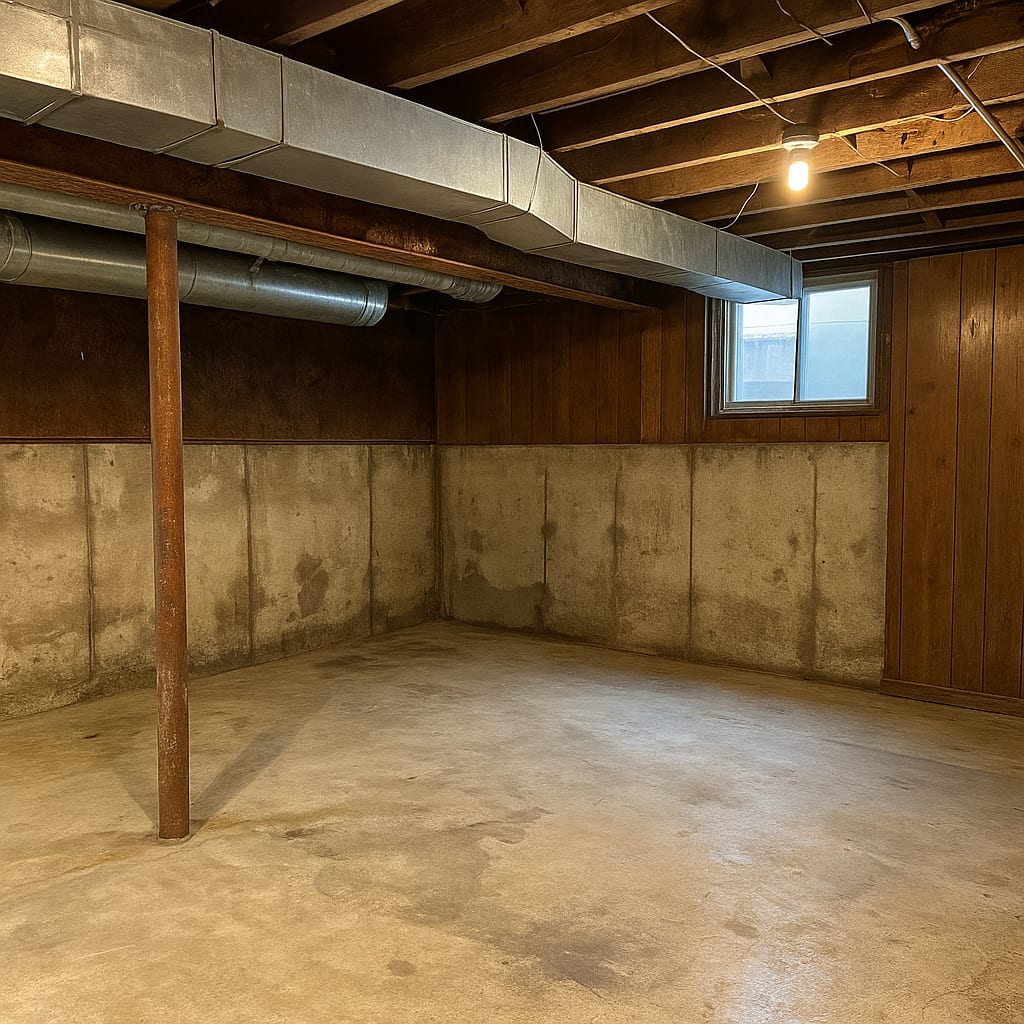
AfterThis Acton home had a previously finished basement that felt cold, dark and slightly damp. The priority was to correct moisture-related issues and modernize the space without a full gut renovation.
MyAurora addressed minor water entry, added proper insulation and vapour barrier, upgraded lighting and replaced old carpet with durable vinyl plank flooring that performs better in basements.
- Scope: Targeted waterproofing, insulation improvements, lighting, new flooring, repaint
- Investment range: approx. $22,000–$28,000
- Timeline: 4–5 weeks with minimal disruption to the main floor
- Result: Dry, brighter basement that now works as a TV area and guest room
- Risk reduction: Fixing moisture before re-finishing helped protect the long-term investment
